Digital transformation
Digital transformation asks how an organization should change the value it provides and the way it works when digital capabilities become available. For a legal service, that might mean moving from an opaque email queue to a service in which people can submit complete requests, understand progress, and receive consistently reviewed outcomes.
It deserves a place before the detailed methods. Process modeling explains how work happens. Software engineering explains how a technical system is built. Transformation establishes why the organization should make the change, what else must change with it, and whether the result is worth sustaining.
Start with a service outcome
Consider three different changes. Scanning a paper form makes the information digital. Connecting a form to a matter system can improve a process. Redesigning intake, triage, staffing, information ownership, and service expectations changes how the legal function operates. These descriptions distinguish the scope of change; they are not a maturity contest in which every organization must attempt the largest intervention.
An outcome such as “reduce avoidable requests for missing information while preserving appropriate review” is more useful than “introduce an AI intake assistant.” The outcome can be tested. It also leaves room to discover that a clearer form, an ownership decision, or a policy change has greater value than a new model.
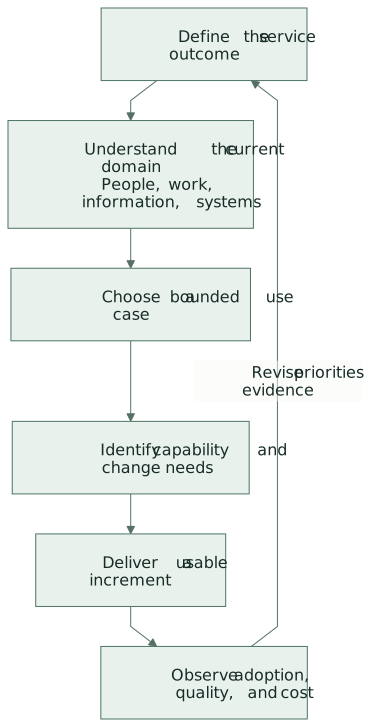
View the relationship model
flowchart TB
    O["Define the service outcome"] --> D["Understand the current domain<br/>People, work, information, systems"]
    D --> U["Choose a bounded use case"]
    U --> C["Identify capability and change needs"]
    C --> I["Deliver a usable increment"]
    I --> E["Observe adoption, quality, and cost"]
    E -->|Revise priorities using evidence| O
The domain is a coherent area of work, such as contract intake or disputes information management. Keeping the first use case bounded makes it possible to learn without pretending that a single prototype transforms the organization.
Four connected changes
A digital service relies on people, process, information, and technology. Changing one can expose weaknesses in the others.

View the relationship model (Mermaid)
flowchart TB
    P["PEOPLE<br/>Ownership, skills, adoption"]
    W["PROCESS<br/>Handoffs, decisions, exceptions"]
    D["INFORMATION<br/>Quality, access, stewardship"]
    T["TECHNOLOGY<br/>Tools, interfaces, reliability"]
    P --> S["A reliable legal service<br/>An outcome people can use and trust"]
    W --> S
    D --> S
    T --> S
    S --> M["Measure use, quality, elapsed time, and cost"]
    M -.-> P
    M -.-> W
    M -.-> D
    M -.-> T
For example, an intake portal does little if nobody owns incomplete submissions. An AI extraction tool struggles when documents have no stable identifiers. A technically correct workflow can fail when the team continues using an unmonitored email route. Each is a design issue with an organizational dimension.
The legal engineer should be able to connect these concerns. Legal Operations may define service priorities and operating measures; lawyers establish relevant legal criteria and decision authority; technical specialists design and maintain infrastructure. The work crosses those boundaries.
Think beyond the first project
A project can deliver an intake service. Someone must then own that service: keep its rules current, respond to failures, manage access, and decide what to improve. This is the useful part of a product mindset. The asset has a life after its initial delivery date.
Reusable capabilities can reduce repeated work. A document identifier service, an approved research method, or a consistent human decision record may support several workflows. Reuse still needs an owner and a clear interface. A shared component that changes without warning can spread failure just as easily as it spreads value.
Make an investment case without inventing benefits
Record the current problem, the proposed change, the cost of implementation and operation, and the evidence that would demonstrate improvement. Separate measured baselines from estimates and assumptions.
| Question | Evidence to seek |
|---|---|
| Does the service solve a real problem? | Interviews, incomplete-request rates, observed delays |
| Will people use the new route? | Pilot adoption, abandoned submissions, support requests |
| Does quality improve? | Review findings, correction rates, missed exception cases |
| Is the change sustainable? | Ownership, maintenance effort, access and training needs |
| Should it expand? | Outcomes across different teams and cases, not only a demo |
A shorter completion time is not automatically a better outcome if important checks disappear. Pair efficiency measures with measures of quality and control.